

Introducing Konabos MightyMouse™ AI for Sitecore Marketplace
Kamruz Jaman - Solution Architect
1 Apr 2026
The first Sitecore Marketplace app powered by subconscious intent capture
Over the past year, there has been a lot of excitement around the Sitecore Marketplace, and for good reason. It opens the door for lightweight apps that can integrate directly into the Sitecore experience through touchpoints like dashboard widgets, context panels, custom fields, and full-screen applications. The goal is faster time to value, more extensibility, and a better developer and editor experience.
Which is great.
But even with all of this progress, and even with AI now helping generate content, accelerate implementation, and reduce repetitive development work, most digital projects still get stuck on the same problem they have always had:
Humans do not actually know what they want.
Or, more accurately, they think they know what they want right up until the moment they see it.
Then it becomes:
- “Can we make it a bit more modern?”
- “Can we try another version?”
- “This is good, but it’s missing something.”
- “I’ll know it when I see it.”
- “Can we explore one more direction?”
- “Actually, can we go back to the first one?”
Naturally, the industry responded to this in the only reasonable way possible: by asking humans to describe what they want in even more detail.
We gave them text prompts.
We gave them voice input.
We gave them chat interfaces.
We gave them forms.
We gave them workshops.
We gave them collaborative whiteboards with digital sticky notes in sixteen slightly different shades of yellow.
And still, somehow, we kept ending up with three-hour calls about whether the hero banner should feel “more premium” but also “more approachable.”
There had to be a better way.
The problem with asking humans what they want
Prompt-driven interfaces are useful. Voice-driven interfaces are useful. Forms are useful. Workshops are... certainly something that exists.
But all of these approaches rely on one flawed assumption:
That humans are both aware of their true intent and capable of expressing it clearly.
This has been disproven repeatedly in digital projects, stakeholder reviews, and almost every homepage redesign ever attempted.
People say one thing and react positively to another.
They ask for simplicity and then request six more content blocks.
They want bold design, but not too bold.
They want innovation, but familiar innovation.
They want AI assistance, but it should somehow behave like a senior strategist, designer, developer, content author, QA lead, and trusted therapist all at once.
And the truth is, the real signal was never in what they typed.
It was somewhere else.

The clue was right in front of us all along
A little while ago, we were watching a video about how reCAPTCHA evolved over the years.
At first, the challenge was simple.
Type the distorted letters.
Then it became: select all the traffic lights.
Then all the bicycles.
Then all the crosswalks.
Then all the buses that may or may not have technically included two pixels of a bus in the bottom-right square.
Now, much of the time, it just asks you to click a checkbox.
On the surface, that seems absurdly simple. To be truly human, you simply have to click the button.
But the checkbox was never really the test.
It was everything that happened before the click.
The tiny mouse movements.
The micro-adjustments.
The slight hesitation.
The imperfect arc.
The almost-correction followed by the actual correction.
The little human wobble as someone moves toward the target.
A robot tends to take the shortest path.
A human tends to take the most human path possible.
And that was the moment everything changed for us.
Because if those tiny subconscious movements can prove that you are human...
Why can’t they also tell us what you actually want?
Introducing Konabos MightyMouse™ AI
After extensive research, experimentation, over-engineering, and what Legal has described as “an extremely uncomfortable number of internal prototypes,” we are proud to announce the next evolution in digital experience creation:
Konabos MightyMouse™ AI
The first Sitecore Marketplace app powered by Subconscious Intent Capture™.
Instead of forcing users to type vague prompts or describe their goals in broad, contradictory language, MightyMouse™ AI captures the real signal: the subtle, involuntary mouse movements that reveal what the user actually means.
Not what they say they want.
Not what they think they want.
Not what they wrote in the requirements document six months ago and have already forgotten.
What they truly want.
At a subconscious level.
As interpreted by your cursor.
How it works
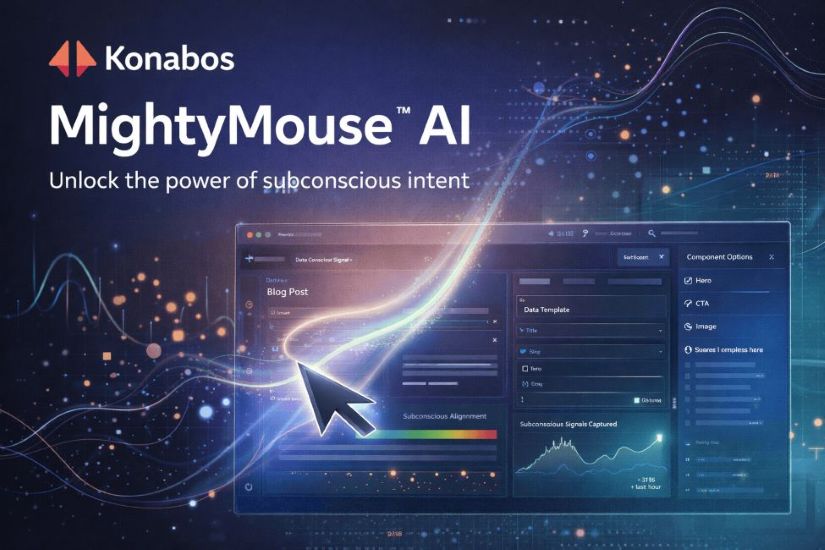
MightyMouse™ AI begins with a very small chat window for basic conscious input, since we understand some organizations still require traditional interaction models for governance purposes.
Users can enter simple starter information such as:
- site URL
- sitemap
- business type
- brand name
- migration source platform
- high-level goals
This initial input is then used only as a rough starting point.
Because, frankly, human language is messy.
The real work begins when MightyMouse™ starts observing cursor behavior.
Using our proprietary Subconscious Experience Mapping Engine (SEME), the app continuously analyzes signals such as:
- hesitation before clicks
- hover duration over specific interface regions
- repeated micro-corrections
- arc shape and curvature
- accidental overshoot
- rage-click density
- scroll reversal patterns
- decision latency
- abandonment loops
- nervous circling around approval buttons
These signals are combined into a dynamic Intent Confidence Model™, allowing MightyMouse™ to distinguish between:
- genuine user preference
- uncertainty
- stakeholder conflict
- executive override
- false confidence
- performative decisiveness
- and what we refer to internally as “PowerPoint-driven delusion”
From there, the app automatically creates the optimal Sitecore solution.
As one would expect.

Why mouse movement is more honest than language
When someone types a prompt, they are filtering.
They are choosing words.
They are trying to sound clear.
They are simplifying.
They are often saying what they think they are supposed to say.
Mouse movement does not do this.
Mouse movement is direct. Immediate. Unfiltered. Quietly revealing.
A user may say they want a minimalist experience, but if they keep hovering over visually rich layouts, pausing over layered content sections, and repeatedly drifting toward more expressive options, MightyMouse™ notices.
A stakeholder may say they are happy with the current design, but if their cursor circles the hero area six times, hesitates over the CTA, moves toward the navigation, then returns to the hero again, the system interprets that correctly as:
“This person is absolutely not happy, but would prefer not to say so out loud in front of others.”
This is where MightyMouse™ truly shines.
It does not just process input. It interprets discomfort.
What MightyMouse™ AI generates
Once enough subconscious intent has been captured, MightyMouse™ AI doesn’t ask for approval, clarification, or another workshop. It simply builds the experience you were trying (and failing) to describe.
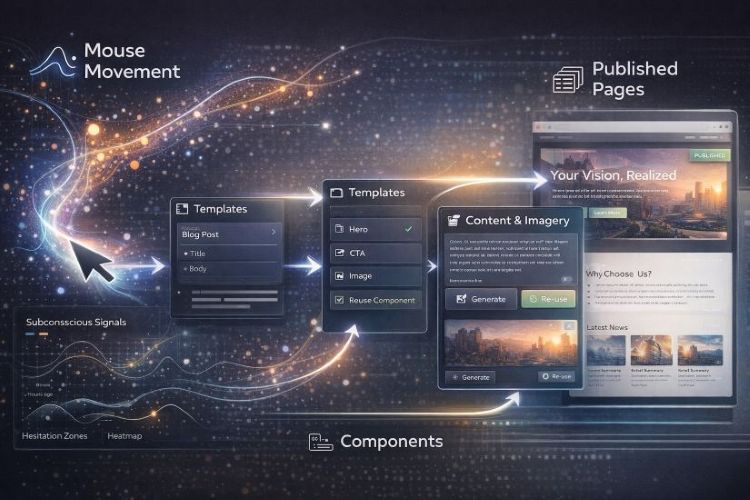
From a few subtle cursor movements, the platform automatically generates:
- Data templates — inferred from behavior, not meetings
- Components & renderings — reusable, flexible, and just opinionated enough to spark future debates
- Page composition — assembled using hesitation zones and “narrative momentum”
- Content & imagery — aligned to your brand tone, confidence level, and tolerance for words like “future-ready”
- React / Next.js front-end — structured, modern, and suspiciously well-organized
- Styling foundation — built on ShadCN with adaptive layers based on subconscious preference
- Full Sitecore assembly — pages, structure, and experience delivered with remarkable confidence
- Component reuse — avoids creating yet another identical CTA with a slightly different Figma name
Which, for the first time, allows teams to move forward without needing to collectively agree on what they were trying to do in the first place.
This has proven especially useful in enterprise environments where design systems contain 14 button styles, 9 card patterns, and a document somewhere explaining why.
Marketplace integration
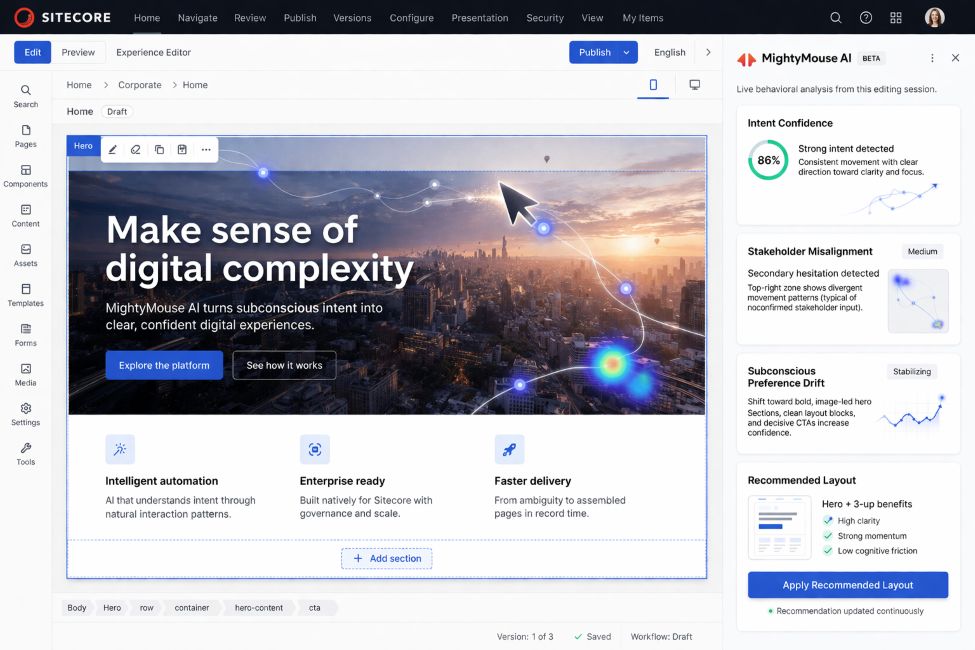
MightyMouse™ AI is built as a native Sitecore Marketplace app, integrating seamlessly across key touchpoints — from dashboards to page-level tools and full-screen experiences.
In practice, that means:
- Dashboard widget — tracks subconscious alignment across pages, templates, and teams
- Context panel — observes behavior in real time and makes recommendations based on emotional certainty
- Custom field extensions — refines content structure directly during authoring
- Full Experience Studio — lets you watch an entire site emerge from the quiet chaos of human indecision
Which finally gives digital teams what they’ve always been looking for:
A way to remove ambiguity… while still making it feel like everyone was involved.
Advanced features
As expected, MightyMouse™ AI includes a range of enterprise-grade capabilities designed to replace ambiguity with… slightly more structured ambiguity.
- Stakeholder Reconciliation Mode™ — merges conflicting feedback into a single direction that no one fully understands, but no one objects to
- Hover-Based Sentiment Analysis™ — measures hesitation and linger time, which is significantly more honest than verbal feedback
- Rage-Click Escalation Mapping™ — detects frustration and automatically shifts toward safer alternatives
- Executive Drift Compensation™ — adjusts for late-stage “strategic input” to protect timelines (and morale)
- Legacy Human Input Mode — still supports prompts for those who remain emotionally attached to workshops
- Confidence-Based Publishing — high-confidence pages move forward, low-confidence ones quietly wait
Because for the first time, publishing decisions are based on something more reliable than whoever spoke last.
Testing and validation
As with any serious enterprise-grade product, we conducted rigorous testing across a wide variety of real-world scenarios.
This included:
- calm users
- indecisive users
- marketers
- developers
- stakeholders
- executives
- people reviewing pages on a Friday afternoon
- and one individual who clicked “looks good” while visibly meaning the exact opposite
The results were extremely promising.
However, one specific area of testing produced some unusual outcomes.
Mouse jiggler compatibility
We are all familiar with the existence of mouse jigglers.
Some are commercial products.
Some are software-based.
Some are built by hand in garages and home offices by people with too much ingenuity and not quite enough fear.
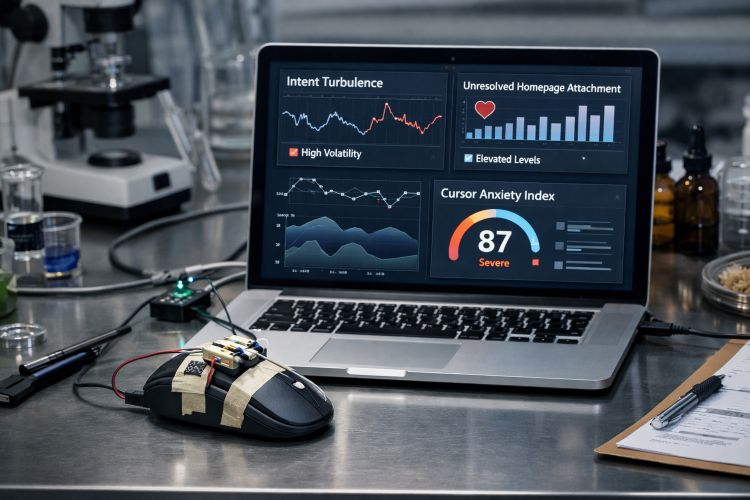
In one memorable internal test, we evaluated a DIY device consisting of a small vibration motor physically attached to a mouse in order to simulate ongoing activity.
The resulting experience generation was, in a word, concerning.
MightyMouse™ interpreted the input as:
- sustained subconscious unrest
- high intent without directional clarity
- emotional turbulence
- and what the system described as “a strong but unresolved relationship with the homepage”
This test automatically generated:
- 47 homepage variations
- 12 competing navigation structures
- 3 different tone-of-voice directions
- one unusually aggressive FAQ page
- and an About Us section that became progressively more philosophical with each regeneration
We have since added partial support for mouse jigglers, although we cannot guarantee the psychological stability of the final output.
For best results, we recommend genuine human ambiguity.
What about brain readers?
A fair question.
Why not simply skip the mouse and read the brain directly?
We considered that.
But after extensive market analysis, we identified three major blockers:
- they would be far too expensive
- they would take up too much room on the average editor’s desk
- they are fake
Much like polygraph machines, they continue to offer the exciting possibility of scientific confidence wrapped around a deeply questionable foundation.
Mouse behavior, by contrast, is real, practical, affordable, and already conveniently attached to most digital workflows.
Why climb into someone’s mind when their cursor is already quietly telling on them?
And what about sleep?
Another excellent question.
There is a popular idea that the subconscious mind reveals our true needs and desires most clearly during sleep.
This may be true.
Unfortunately, our early attempts to create a sleep-driven authoring workflow raised several legal concerns across multiple jurisdictions, particularly around labor law, consent, and the definition of “working while unconscious”. And we've all seen Minority Report, let's not go there.
As a result, we have temporarily paused development of DreamCapture™ for Sitecore.
For now.
A better future for digital delivery
For years, the digital industry has focused on making tools more powerful, more connected, and more AI-driven.
And that has been valuable.
But perhaps the bigger breakthrough was not in generating more options.
Perhaps it was in finally listening to the one signal that has been quietly telling the truth this entire time.
Not the prompt.
Not the meeting notes.
Not the workshop board.
Not the comment thread.
Not the approval email that begins with “Overall this looks great…”
The mouse.
Because the checkbox was never the test.
And, if we are being honest, neither was the feedback.

See MightyMouse™ AI in action
We know many of you will want to see the platform working in a real-world scenario.
So we have prepared a live demonstration showing exactly how MightyMouse™ AI captures subconscious intent and transforms it into a complete Sitecore experience.
Watch the demo here: https://www.youtube.com/watch?v=dQw4w9WgXcQ
We recommend watching the full video carefully, especially the cursor movement in the first few seconds.
It reveals more than you think.
Join the Early Adopt A Mouse program
If you are interested in using MightyMouse™ AI, joining the early access program, or validating whether your stakeholders are consciously aligned with their own cursor behavior, please get in touch.
If nothing else, we would be happy to review your mouse patterns and let you know whether your homepage indecision is structural, emotional, or just inherited from the steering committee.
Demo of real AI in action
While MightyMouse™ AI represents a significant leap forward in subconscious experience generation, some organizations may still prefer a slightly more deterministic approach.
For those customers, we are actively working on real-world AI-assisted tooling that helps accelerate migration and build workflows into Sitecore’s modern SaaS ecosystem, reducing manual effort while still keeping humans appropriately involved at the right stages.
So if the idea of moving from an existing site into a modern Sitecore build with a lot less repetitive effort sounds useful, get in touch and let's have a real demo.
Unlike MightyMouse™, that part is not a joke.
Probably.
Happy April Fools.

Kamruz Jaman
Kamruz is a 14-time Sitecore MVP who has worked with the Sitecore platform for more than a decade and has over 20 years of development and architecture experience using the Microsoft technology stack. Kamruz is heavily involved in the Sitecore Community and has spoken at various User Groups and Conferences. As one of the managing partners of Konabos Inc, Kamruz will work closely with clients to ensure projects are successfully delivered to a high standard.
Share on social media