
The Shift from Ranking to Being Understood: What AI Search Means for Your Digital Strategy
Akshay Sura - Partner
9 Jan 2026
If you follow digital marketing news, you've seen the headlines. AI is "destroying" SEO. ChatGPT is "replacing" Google. The reality is more interesting than the panic suggests.
Search isn't dying. It's fragmenting.
Semrush analyzed over 10 million keywords and found that AI Overviews now appear in about 16% of Google searches, down from a peak of nearly 25% in mid-2025. That's significant, but it's not the end of search as we know it. What matters more is the shift in which queries trigger AI Overviews. Commercial and transactional queries have more than doubled since early 2025.
At the same time, ChatGPT, Perplexity, and Claude have become real research tools. BCG's consumer research shows that trust in AI for purchase decisions is growing faster than most brands expected.
The question isn't whether AI search matters. It's whether your content is built for it.
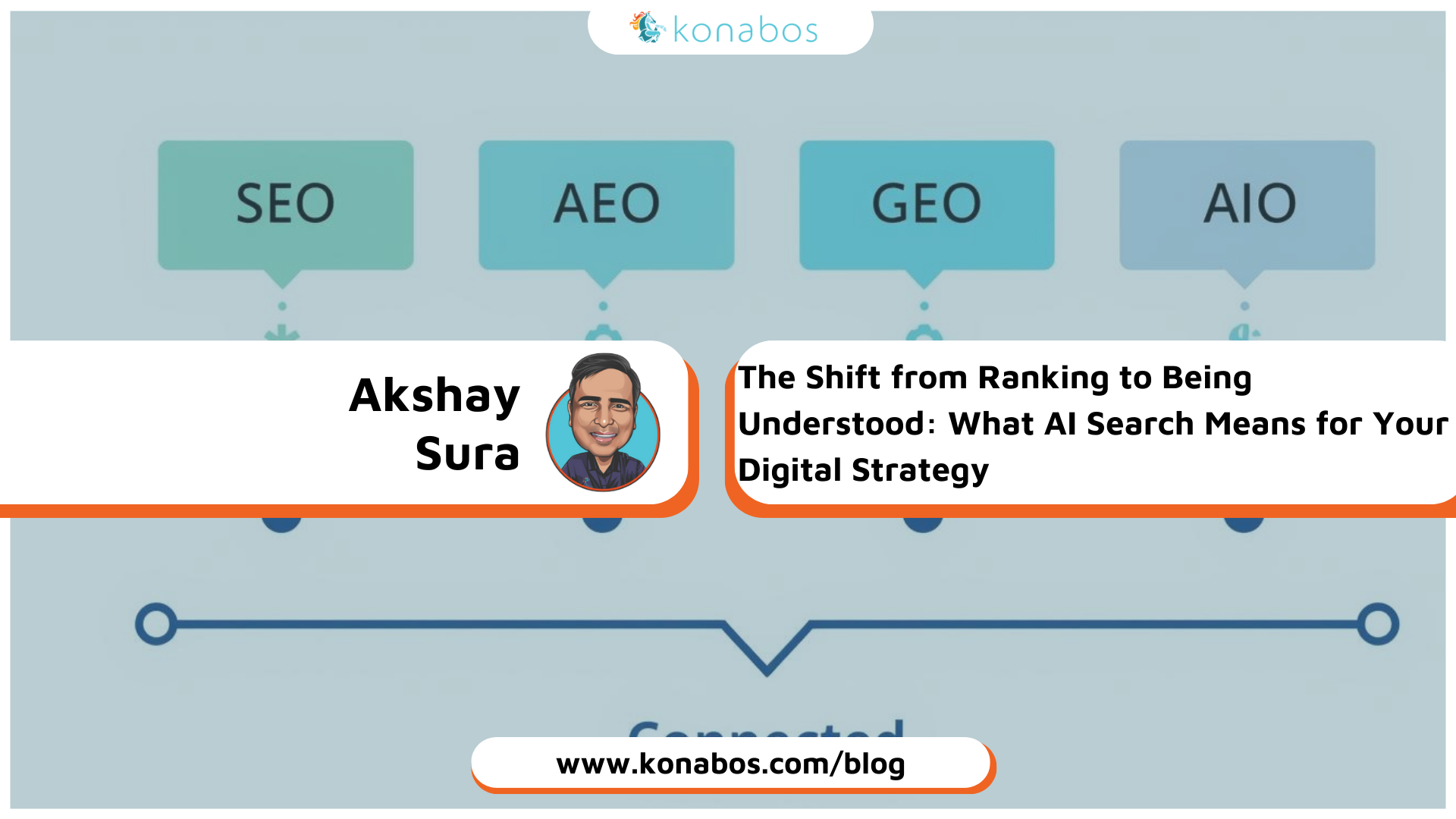
Beyond SEO: The Four Pillars
The industry has settled on a framework that extends traditional SEO into three additional areas. The terminology varies, but the concepts are consistent.
SEO is the foundation. Technical health, keywords, backlinks, page speed, mobile experience. Still important. Still evolving. But no longer enough on its own.
AEO (Answer Engine Optimization) is about structuring content so AI assistants can pull direct answers. ChatGPT, Siri, Alexa, Google Assistant, and Google's own AI Overviews all work this way. They don't browse. They extract. Your content needs to be extractable.
GEO (Generative Engine Optimization) focuses on getting your content cited in AI-generated responses. When someone asks Perplexity or ChatGPT about your industry, do they reference you? GEO is about citability, authority signals, and content structure that AI systems trust.
AIO (AI-Oriented Optimization) covers the technical side. Structured data, semantic HTML, configuration files like llms.txt. The infrastructure that helps AI crawlers understand what your site is about.
These aren't separate strategies. They're layers of the same approach.
What the Data Shows
Forget predictions. Here's what we can measure:
AI Overviews are moving beyond informational queries. In early 2025, over 90% of AI Overview triggers were informational. By late 2025, commercial and transactional queries made up nearly a third. Navigational queries, including branded searches, jumped from under 1% to over 10%.
Longer, more specific queries are triggering AI features. The long-tail, question-based content that content marketers have relied on for years is now prime territory for AI extraction. This isn't a new direction. It's a sharpening of what already worked.
Schema markup matters more than ever. Google's documentation shows that pages with valid structured data have better odds of being referenced in AI responses. Practitioners at Walker Sands and Fulcrum Digital have seen this play out with clients.
Zero-click behavior is complicated. AI Overviews appear more often on searches that don't generate clicks, but Semrush found that adding an AI Overview actually increased click-through slightly. And zero-click rates for AI Overview queries have been declining through 2025.
The takeaway isn't "SEO is dead." It's "SEO alone leaves visibility on the table."
Where to Start
It's tempting to treat this as a massive project requiring new tools, new agencies, and new budgets. Usually, that's premature.
Most organizations already have the foundation. The gaps tend to fall into three areas:
1. Content Structure
AI systems don't read like humans. They parse, extract, and reassemble. Content written for humans may be invisible to AI.
Check these:
- Do your pages answer questions directly, or bury answers in paragraphs?
- Can AI quote your key points as standalone statements?
- Do your headers match natural questions? ("What is X?" / "How does Y work?")
2. Structured Data
Schema markup isn't new, but it matters more now. AI systems use it to understand what content represents, not just what it says.
Check these:
- Do you have Organization, WebPage, and Article schema where appropriate?
- Is FAQ content marked up with FAQPage schema?
- Are how-to guides using HowTo schema?
- Is your schema valid, or just present?
3. AI Crawler Access
AI systems have their own crawlers now. GPTBot (OpenAI), ClaudeBot (Anthropic), PerplexityBot. Your robots.txt might be blocking them without you knowing.
Check these:
- Does your robots.txt address AI crawlers?
- Do you have an llms.txt file?
- Is your HTML clean enough for machine parsing?
What This Means for Your Team
Marketing leaders: This extends your SEO investment, not replaces it. The fundamentals still apply. What's new is a set of optimizations that make your content accessible to AI systems.
Content teams: The shift is from "content that ranks" to "content that answers." You don't have to abandon storytelling. You do need to structure content so AI can extract the key points.
Technical teams: Schema markup and AI crawler configuration are now core concerns, not nice-to-haves.
Executives: Thoughtful adaptation beats frantic reaction. This is a refinement, not a revolution.
Tools Worth Knowing
The tooling for AI search optimization is still developing. A few resources:
- Google's Rich Results Test for schema validation
- Semrush for AI Overview tracking
- Conductor's AEO/GEO tool comparison for category overview
- Schema.org for structured data documentation
We built RankReady to give teams a quick read on where they stand across all four pillars. It checks SEO, AEO, GEO, and AIO signals and flags specific issues with recommendations. It's free and takes about 30 seconds.
Try it here: https://rankready.konabos.ai/
AI search isn't replacing traditional search. It's adding to it. The organizations that do well won't be the ones who abandon SEO. They'll be the ones who extend it.
The real shift is from being ranked to being understood. Search engines returned links. AI systems return answers. If your content can't be extracted, synthesized, and cited, you're missing a growing share of how people find information.
Most of the work isn't new. Structured data, clear answers, clean markup, technical accessibility. Organizations that have done this well for years are already positioned. Those that haven't now have a clear priority list.
Start by understanding where you stand. Then decide what to fix based on what you find, not on what the headlines say.
This post draws on research from Semrush, Walker Sands, BCG, Fulcrum Digital, CXL, Profound, and others.
References
- Semrush: AI Overviews' Impact on Search in 2025
- BCG: Consumers Trust AI to Buy Better
- Walker Sands: Generative Engine Optimization (GEO): What to Know in 2025
- Fulcrum Digital: Why AEO Is the New Search Frontier in 2025
- CXL: Answer Engine Optimization (AEO): The Comprehensive Guide for 2025
- Profound: A Marketer's Playbook for Answer Engine Optimization (AEO) in 2025
- Profound: 10-Step Framework for Generative Engine Optimization (GEO)
- Hive Digital: How AI Is Rewriting Search and How Marketers Can Adapt
- LinkedIn: AI Search Optimization Strategy
- Conductor: The 10 Best AEO/GEO Tools in 2025

Akshay Sura
Akshay is a nine-time Sitecore MVP and a two-time Kontent.ai. In addition to his work as a solution architect, Akshay is also one of the founders of SUGCON North America 2015, SUGCON India 2018 & 2019, Unofficial Sitecore Training, and Sitecore Slack.
Akshay founded and continues to run the Sitecore Hackathon. As one of the founding partners of Konabos Consulting, Akshay will continue to work with clients to lead projects and mentor their existing teams.
Share on social media